
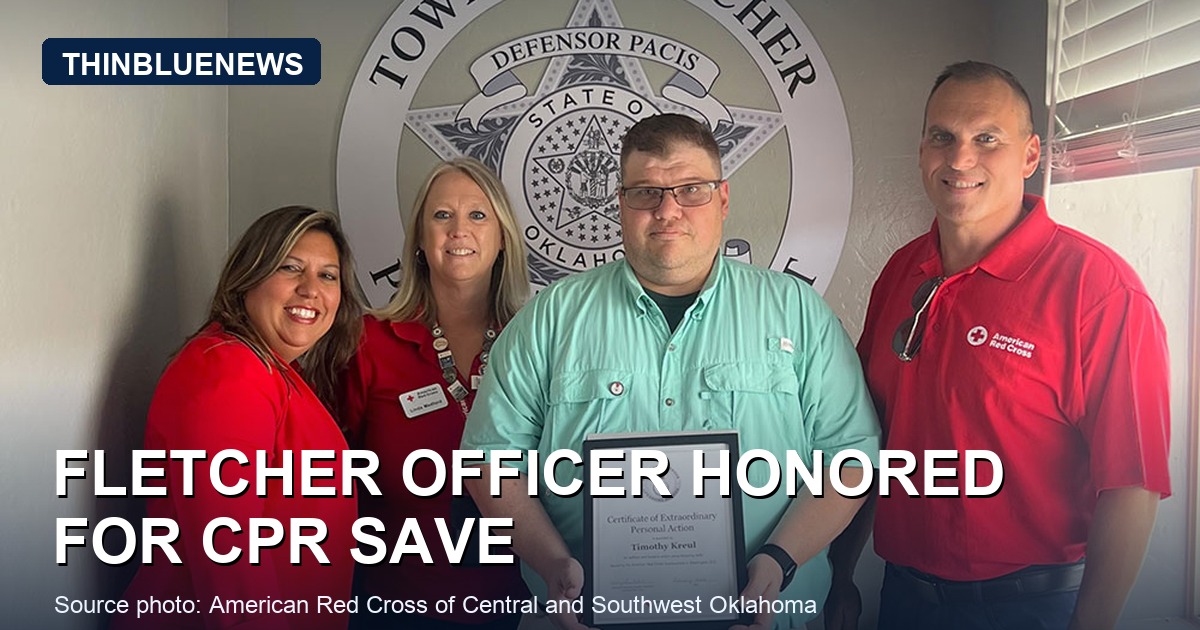
FLETCHER, Oklahoma — Fletcher Police Officer Timothy Kreul received an American Red Cross Lifesaving Award after the organization said he used CPR to help save a 65-year-old man who was unresponsive and not breathing.
The American Red Cross of Central and Southwest Oklahoma announced that Kreul was presented the national award for his actions during a January medical emergency.
CPR before paramedics arrived
According to the Red Cross, Kreul was on duty when he was called to a home where a 65-year-old man was unconscious, had no pulse and was not breathing.
The organization said Kreul immediately started CPR and successfully resuscitated the man twice. When the man’s heart stopped again, Kreul continued CPR until emergency medical services arrived and helped with additional lifesaving measures.
Paramedics were able to revive the patient again and transport him to Comanche County Memorial Hospital, according to the Red Cross. The organization said the man made a full recovery.
Recognition from the Red Cross
Red Cross staff members and Fletcher Police Chief Jason DeLonais presented Kreul with the Lifesaving Award on Aug. 12 at the Fletcher Community Center, the organization said.
“CPR, first aid and AED are critical to first responders,” Kreul told KSWO in a statement quoted by the Red Cross. “We’re the first on the scene. Most of the time, we have to assess the situation appropriately, and with CPR, first aid, if we weren’t trained, we would lose a lot of lives.”
Loida Haffener Salmond, executive director of the Red Cross of Central and Southwest Oklahoma, said in the announcement that emergencies can happen anywhere and that skills like CPR and first aid may be needed unexpectedly.
For Support Law Enforcement readers, Kreul’s recognition is a practical reminder of the first-responder work that happens before an ambulance reaches the scene: checking for breathing, starting compressions, staying with the patient and continuing care until the next team arrives.
Sources reviewed
- American Red Cross: “Fletcher police officer receives Lifesaving Award”
- KSWO: Fletcher officer receives American Red Cross national lifesaving award
- American Red Cross source photo of Officer Timothy Kreul receiving the award
Editorial note: ThinBlueNews used Red Cross and local-source facts and a real Red Cross award photo. The article does not identify the patient and does not create fake rescue or medical-emergency imagery.