
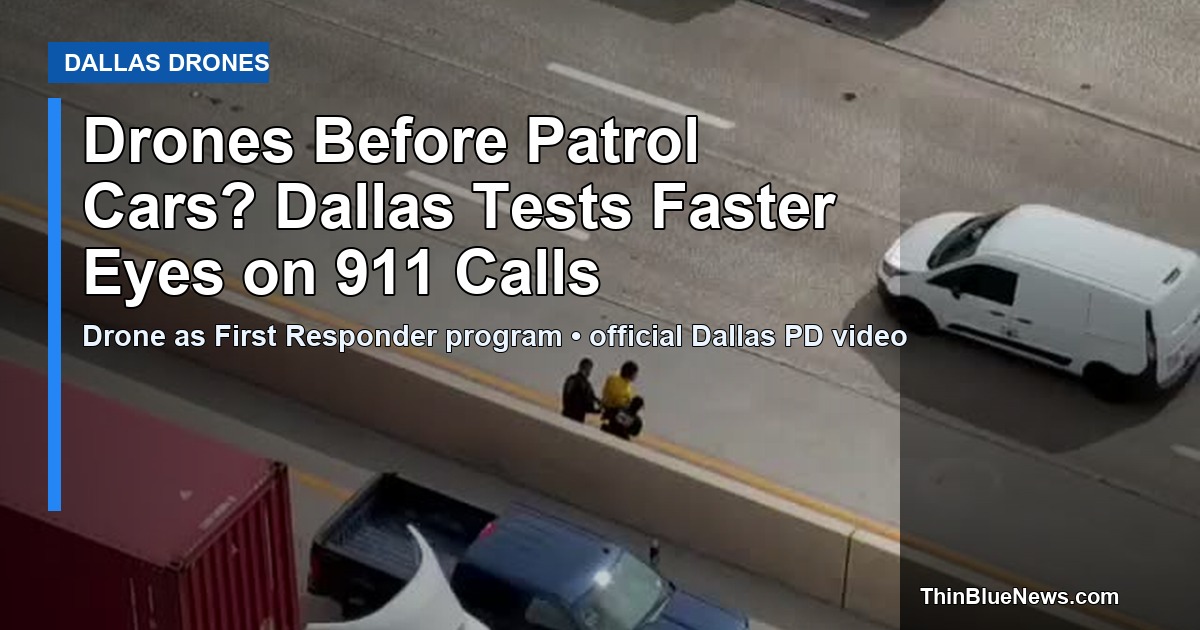
DALLAS — Dallas police and fire crews are adding a new tool to the first minutes of some emergency calls: drones that can reach the area before patrol cars or fire apparatus arrive.
Watch the Support Law Enforcement Reel
Video source: Dallas Police Department. ThinBlueNews edited the related Support Law Enforcement Reel with visible source attribution. Watch the Reel on Facebook if the embedded player does not load.
The Dallas Police Department launched a Drone as First Responder program on May 21, according to a Police1 report that cited the department and embedded an official Dallas Police Department video.
Police1 reported that the program uses eight remotely operated Skydio drones stationed at Dallas Fire-Rescue facilities. The drones are operated through the department’s Fusion and Real Time Crime Center and are intended to respond within a two-mile radius of their base locations, which officials selected using police and fire call data.
Eyes on the scene before responders arrive
The goal is simple: give responders real-time aerial information before they step into a scene. Police1 reported that the drones are designed to arrive faster than patrol vehicles and can provide live intelligence to responding officers. The devices are equipped with thermal imaging cameras and loudspeakers.
Dallas Police Chief Daniel Comeaux said the program is meant to improve response times and officer safety while reducing unnecessary deployments, according to Police1.
“Even during our training, our pilots were able to clear three holding calls in an hour with one drone,” Comeaux said, according to the report.
Dallas Fire-Rescue is also part of the program. Police1 reported that drones can be dispatched ahead of fire apparatus on reported structure fires, giving commanders a look at conditions before crews arrive.
Officer safety and public guardrails
For supporters, the officer-safety case is obvious: a drone may be able to show whether a call involves a crash, a fire, a suspect, a blocked roadway, or another hazard before responders physically arrive.
At the same time, any public-safety drone program will raise reasonable questions about privacy, data handling, retention, supervision and when a drone should or should not be used. Clear local rules matter, especially as more agencies consider similar tools.
For law enforcement families and supporters, the Dallas program is another example of departments testing technology that could help officers, firefighters and dispatchers make better decisions during the most uncertain moments of a call.
Sources and attribution
- Police1 reported the Dallas police/fire Drone as First Responder program details.
- Dallas Police Department public Facebook Reel provided the official video used for the related social Reel with visible attribution.