
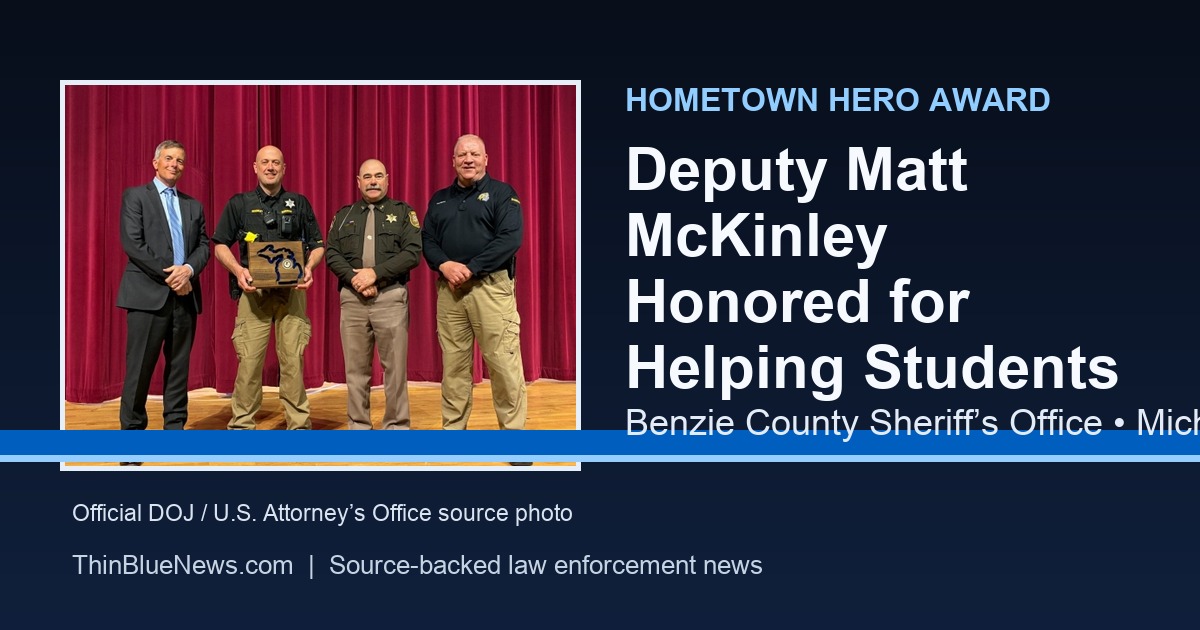
A Michigan deputy sheriff is being recognized nationally for work that reached beyond school safety and into the daily needs of students under his care.
The U.S. Attorney’s Office for the Western District of Michigan announced that the Justice Department gave its Hometown Hero Award to Benzie County Deputy Sheriff Matt McKinley.
According to the official May 21 release, the award ceremony was held at Benzie Central High School in Benzonia, Michigan, and was attended by students, friends, family, the school’s student resource officer, and area law enforcement.
The Hometown Hero Award is part of the Freedom 250 celebration marking the 250th anniversary of the founding of the United States. U.S. Attorney’s Offices in all 93 federal districts were asked to honor an outstanding member of the law-enforcement community during the week leading up to Memorial Day, the release said.
McKinley was selected from nominees across the Western District of Michigan. The U.S. Attorney’s Office said he was chosen for his work with underprivileged kids in Benzie County, where he serves as the student resource officer for the Benzie County School system.
Although McKinley’s formal role focused on student safety, the release said he saw other ways to help. When some students did not appear to have enough to eat, he set up an in-school food pantry where hungry students could get a healthy snack.
When he learned that other students were struggling with tattered or dirty clothes, McKinley organized a community-wide effort to stock new clothing. Those efforts became known as the “McKinley’s Kids” drives and brought the Benzie County community together, according to the U.S. Attorney’s Office.
U.S. Attorney Timothy VerHey said McKinley “is a great example of what it means to be an American,” adding that the deputy rolls up his sleeves when he sees a problem he can fix.
For law-enforcement supporters, the story is a reminder that service is not always a siren or emergency call. Sometimes it is a school resource officer noticing hunger, clothing needs, and dignity — then building a local response around kids who need help.