
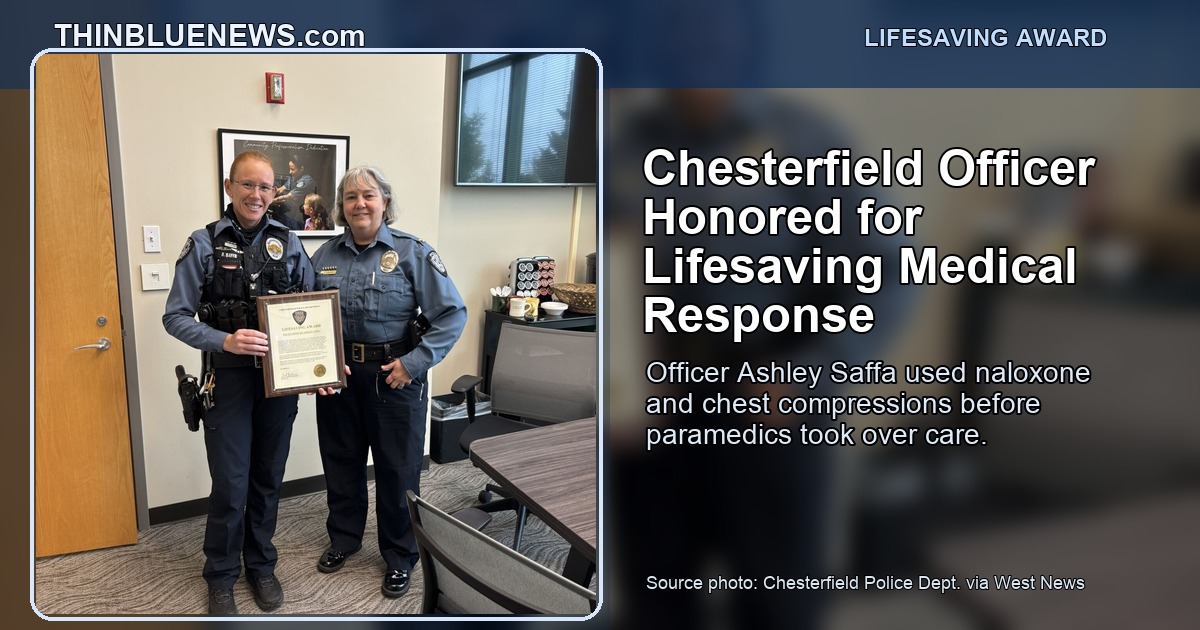
CHESTERFIELD, Missouri — Chesterfield Police Officer Ashley Saffa has been recognized with the department’s Lifesaving Award after a medical-emergency response in which she administered naloxone and began chest compressions, according to West Newsmagazine.
The outlet reported that Chesterfield Police Chief Cheryl Funkhouser presented Saffa with the award for helping save the life of a man on Oct. 27, 2025.
According to the commendation quoted by West Newsmagazine, Saffa responded to 17195 Chesterfield Airport Road for a call involving a man who had collapsed, was turning blue and appeared to be having a seizure.
Naloxone, CPR and a full recovery
The report said Saffa assessed the patient and the scene, recognized a life-threatening emergency and observed signs of possible opioid use. She administered naloxone, which appeared to have a limited effect, then continued lifesaving care by giving chest compressions.
Paramedics from the Monarch Fire Protection District took over care and transported the man to St. Luke’s Hospital, where he made a full recovery, according to the report.
“Officer Saffa’s actions on this day were instrumental in preventing a fatal outcome and preserving the life of a human being. Her ability to remain calm, accurately assess the scene and administer appropriate lifesaving care is a testament to her skill as a police officer,” Funkhouser stated in the commendation quoted by West Newsmagazine.
Recognition for the quiet calls
For Support Law Enforcement readers, the story is a reminder that lifesaving police work is not always a dramatic chase or rescue video. Sometimes it is an officer arriving first, recognizing the signs of a medical crisis and starting care before paramedics can take over.
ThinBlueNews is not naming the patient and is limiting medical details to what was publicly reported by the source.
Source reviewed
Editorial note: ThinBlueNews used a real department-courtesy recognition photo as published by West Newsmagazine. No AI-generated rescue or medical-emergency imagery was used.